
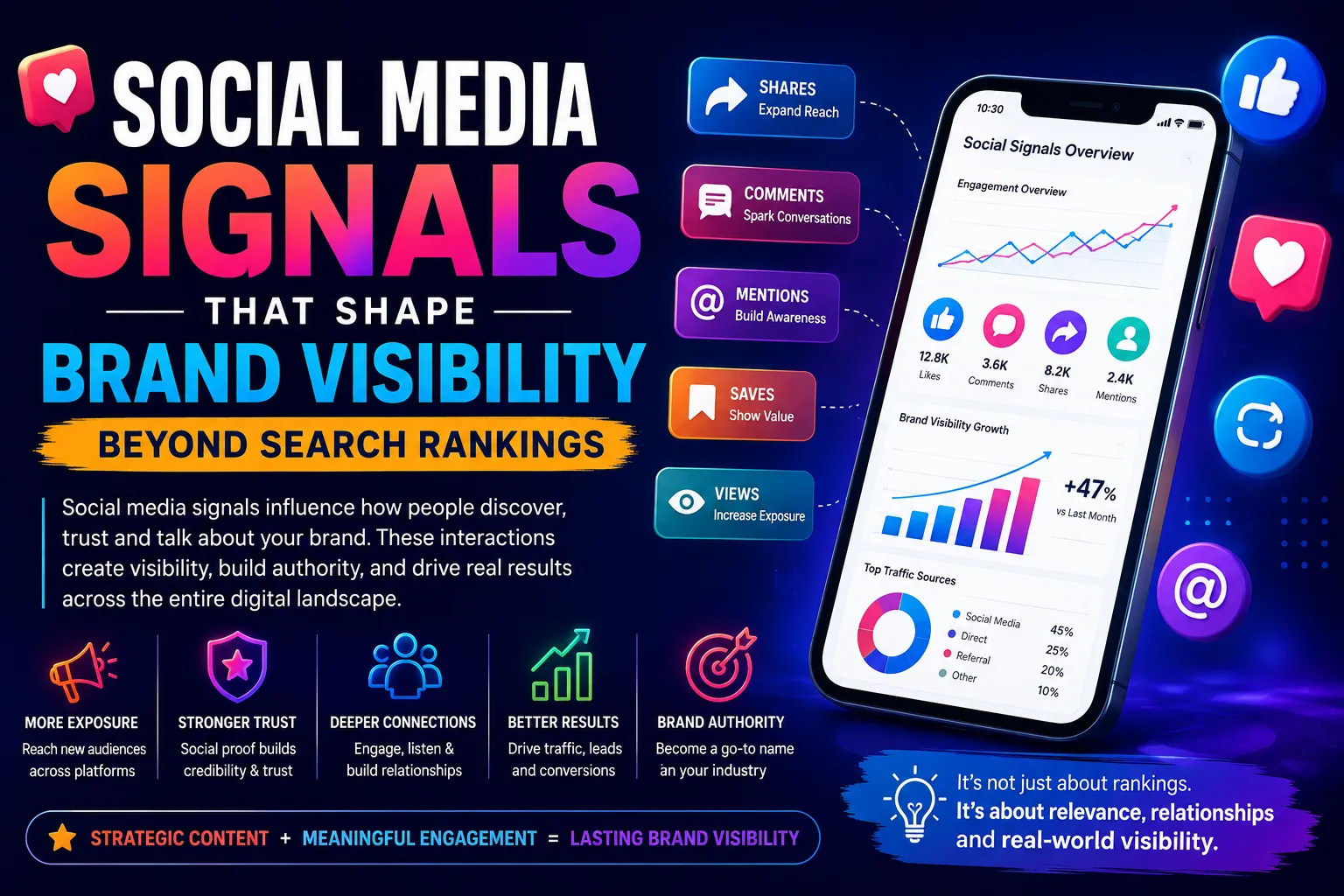
Brand visibility is no longer limited to where a website appears on a search results page. People discover businesses through Instagram posts, YouTube videos, LinkedIn discussions, TikTok content, recommendations, and conversations happening across online communities. These interactions create social media signals that can influence how familiar, trustworthy, and relevant a brand feels before someone ever visits its website. Social signals do not simply mean follower counts or the number of likes on a post. They include sharing behavior, mentions, comments, branded searches, content discussions, and the broader attention a company earns online. Understanding these signals helps businesses build visibility that extends beyond traditional search rankings. A strong social presence can support brand recall, audience relationships, referral traffic, and long-term digital authority.
What Are Social Media Signals?
Social media signals are measurable or observable interactions that indicate how people respond to a brand or its content across social platforms. Examples include likes, comments, shares, saves, mentions, reposts, video engagement, profile visits, and discussions involving a brand name. Some signals are public and easy to measure, while others can be observed through analytics, referral traffic, or changes in branded search behavior. Their value comes from what they reveal about audience attention rather than from the number alone. A post shared by industry professionals, for instance, may create more meaningful visibility than thousands of passive impressions.
Why Social Signals Matter for Brand Visibility
Social activity can increase the number of places where potential customers encounter a brand. A useful LinkedIn post may be shared among professionals, while an Instagram Reel can introduce a product to people who were not actively searching for it. When content repeatedly appears in relevant conversations, the brand becomes easier to recognize and remember. This familiarity can influence future purchasing decisions because people often prefer businesses they have encountered before. Social visibility therefore works alongside search visibility by creating additional discovery paths.
Shares and Reposts Create Distribution
Sharing is one of the strongest indicators that content has enough value for someone to associate it with their own network. A practical guide, industry insight, entertaining video, or useful checklist can travel well beyond the original audience when people repost it. Each share creates another opportunity for someone unfamiliar with the brand to discover it. For businesses, this can produce referral visits and new conversations without relying entirely on paid advertising. The key is creating material that people naturally want to pass along rather than asking for shares without offering genuine value.
Comments and Conversations Build Recognition
Comments provide a different type of signal because they show that content has prompted people to respond. Meaningful discussions can demonstrate expertise, answer customer questions, and reveal what an audience actually cares about. A software company that consistently explains technical topics in its comment sections may become associated with helpful expertise. Similarly, a local business that responds thoughtfully to customer questions can strengthen its reputation and encourage repeat interaction. The quality of these conversations often matters more than simply accumulating a large comment count.
Brand Mentions and Community Discussions
Brand mentions can extend visibility into places a company does not directly control. Customers may discuss products in online communities, creators may mention a service in videos, or industry publications may reference a company during broader conversations. These discussions can expose the brand to audiences that would otherwise be difficult to reach. Businesses should monitor relevant mentions so they can understand public sentiment, identify questions, and respond when appropriate. Genuine third-party discussion can be especially valuable because people may view independent recommendations differently from direct advertising.
Branded Searches and Social Discovery
Social media can also influence what people search for later. Someone might first discover a company through a Reel, remember its name, and search for the brand days later when they need its product. This creates a connection between social discovery and search behavior without requiring the original discovery to happen through Google. Tracking branded search trends, direct traffic, referral sources, and social engagement can help businesses understand these relationships. A rise in brand-related searches following successful campaigns may indicate increasing awareness even when conventional rankings remain unchanged.
Creating Content That Generates Useful Signals
Not every post deserves the same distribution strategy. Businesses should identify topics that solve customer problems, answer common questions, explain complex ideas, or provide practical examples. Educational carousels, short tutorials, customer stories, original research, demonstrations, and industry opinions can encourage people to interact and share. Content should also be adapted to the platform rather than copied mechanically across every channel. A strong strategy focuses on relevance and usefulness first, allowing engagement to develop naturally from audience interest.
Measure More Than Follower Count
Follower growth can provide context, but it should not be treated as the primary measure of brand visibility. Businesses should examine engagement rates, shares, saves, mentions, referral traffic, branded searches, video completion, profile activity, and qualified inquiries. These measurements can reveal whether social activity is attracting the right people and creating meaningful interest. For example, a smaller account that generates consistent website visits and customer conversations may be more valuable than a larger account with weak engagement. Measuring multiple signals helps businesses make better marketing decisions.
Conclusion
Social media signals can shape brand visibility in ways that extend far beyond traditional search rankings. Shares can introduce content to new networks, comments can demonstrate expertise, mentions can build credibility, and social discovery can encourage people to search for a brand later. None of these signals should be viewed as a replacement for useful content, strong products, or sound SEO. Instead, they form part of a wider digital presence where different channels reinforce one another. Businesses that focus on meaningful conversations, useful information, authentic community participation, and measurable audience behavior can build stronger brand recognition over time. The goal is not to chase engagement numbers, but to create signals that reflect genuine interest and lasting visibility.
FAQs
Do social media signals directly improve search rankings?
Social media signals such as likes and shares are not generally treated as direct ranking factors in the same way as traditional search signals. However, social activity can indirectly support visibility by increasing content discovery, generating referral traffic, attracting mentions, and encouraging people to search for a brand. These secondary effects can contribute to a stronger overall digital presence.
Which social media signal is most valuable for a brand?
There is no single signal that is most valuable for every business. Shares may be important for expanding reach, while comments can demonstrate audience interest and mentions can contribute to brand awareness. A business should prioritize signals connected to its objectives. For example, qualified website visits and customer inquiries may matter more than high engagement numbers for a service-based company.
Can social media increase branded searches?
Yes, social content can contribute to increased branded searches by introducing people to a company they did not previously know. A user may discover a brand through a video or recommendation and search for it later when they need more information. Businesses can compare social campaign periods with branded search trends and direct traffic to better understand whether awareness is increasing.
How can small businesses generate stronger social signals?
Small businesses can focus on highly relevant content instead of trying to reach everyone. Practical tutorials, local insights, customer stories, demonstrations, answers to common questions, and behind-the-scenes content can encourage meaningful interaction. Responding to comments and participating in relevant community discussions also helps. Consistency matters because repeated useful interactions make it easier for an audience to recognize and remember a brand.
Should brands focus on followers or engagement?
Brands should consider both, but engagement and audience relevance usually provide more useful context than follower count alone. A large audience with little interaction may produce limited business value, while a smaller community can generate conversations, referrals, and sales. Businesses should track several indicators, including shares, saves, comments, mentions, referral traffic, inquiries, and conversions, to evaluate whether social activity is actually supporting growth.